Launch a coin from a thread.

/sqt/ - simple questions thread (aka /qtddtot/)
Previous thread: >>17016986
>what is /sqt/ for?
Basic questions regarding maths and science. Also homework.
>where do I go for advice?
>>>/sci/scg or >>>/adv/
>where do I go for other questions and requests?
>>>/wsr/ >>>/g/sqt >>>/diy/sqt etc.
>how do I post math symbols (Latex)?
rentry.org/sci-latex-v1
>a plain google search didn't return anything, is there anything else I should try before asking the question here?
scholar.google.com
>where can I search for proofs?
proofwiki.org
>where can I look up if the question has already been asked here?
warosu.org/sci
eientei.xyz/sci
>how do I optimize an image losslessly?
trimage.org
pnggauntlet.com
>how do I find the source of an image?
images.google.com
tineye.com
saucenao.com
iqdb.org
>where can I get:
>books?
open-slum.org (NEW!)
stitz-zeager.com
openstax.org
activecalculus.org
>articles?
sci-hub.st
>book recs?
4chan-science.fandom.com/wiki//sci/_Wiki
math.ucr.edu/home/baez/physics/Administrivia/booklist.html
>online courses and lectures?
khanacademy.org
>charts?
imgur.com/a/pHfMGwE
imgur.com/a/ZZDVNk1
>tables, properties and material selection?
www.engineeringtoolbox.com
www.matweb.com
www.chemspider.com
Tips for asking questions here:
>avoid replying to yourself
>ask anonymously
>recheck the Latex before posting
>ignore shitpost replies
>avoid getting into arguments
>do not tell us where is it you came from
>do not mention how [other place] didn't answer your question so you're reposting it here
>if you need to ask for clarification fifteen times in a row, try to make the sequence easy to read through
>I'm not reading your handwriting
>I'm not flipping that sideways picture
>I'm not google translating your spanish
>don't ask to ask
>don't ask for a hint if you want a solution
>xyproblem.info

What's the point of publishing industry when the quality of published materials can be the same or lower than on arxiv / biorxiv?
Everything could be much more simple: free publication for everyone, but
1. You have to publish as a representative of a registered institution;
2. Formal critique comes in a form of publication as well;
3. An institution cannot publish as long as there is any unaddressed critique;
4. The only way to retract your publication is to publish a "we fucked up" message, which will accompany any future publication from that institution.
Want to publish quickly for the sake of pushing scientific thought forward ASAP? Cool, share your preprints.
Want to publish a serious research? Go ask your peers to review it first, then submit a serious work.
Want to publish bad-faith research or critique? Lol, good luck publishing in the future.
Simple, almost zero cost for index operator, verification is delegated to scientists who can shit on each other at the risk of their visible reputation if their shitting is unwarranted.
>>17088803
good idea, except we need to drop points 1, 2, 3, and 4
Coins launched here are paired with $4CHAN on pump.fun and 100% of their creator fees are burned. A coin listed under a thread is not endorsed by the thread’s posters or by 4chan.

What if you have a steel ball in space which is heated up to 1000 degrees celcius. The ball is inside of a spherical shell and the insides of that shell are covered in perfectly reflective mirrors. All the radiation that escapes from the ball bounces from the mirror right back into the ball. Now it never cools down and entropy doesn't have a chance to increase in the universe. Did this break the laws of physics?
>>17088868
> Did this break the laws of physics?
Yes and no.
No: The 2nd Law of Thermodynamics says entropy will never decrease in a closed system, it doesn't say entropy will always increase - for example a system in equilibrium.
Yes: A mirror that perfectly reflects across all wavelengths is only a thought experiment, for various reasons it can't physically exist.
Why doesn't drag increase linearly. I've spent a bit trying to work this out in my mind but got nothing.
Please refrain from giving mathematical answers, I failed calc 1 twice
>>17088966
> Please refrain from giving mathematical answers
Then the simplest answer would be conservation of energy. To push through the fluid means giving energy to the mass that has to move. That's just kinetic energy, so that must mean drag scales with velocity squared (which it does)
>>17089000
That doesn't really do much for me.
Do you have a more physical explanation? I was thinking it'd be along the lines of the the atoms of the medium being moved through having less time to move out of the way the faster the object moves, and so a sort of backlog of unmoved air builds up in front of the object, but I'm not sure, because if this were how drag worked, I'd think the pointy shapes they use on supersonic planes would be just as effective at subsonic speeds.

If a coin lands heads, there is 50% probability that the next coin is rigged so that it lands heads with 80% probability. If the rigged coin also lands heads, it stays rigged for the next throw. If it lands tails, the original coin is returned. What is the expected proportion of heads if the number of throws approaches infinity?
>>17089014
It's nothing more than an object moving through a fluid has to displace that fluid. You can't 100% avoid the math because the amount of distance the object moves means a certain amount of fluid displaced, and that means a conservation law
(force / momentum / energy - take your pick). They all give you the same drag equation.
>>17089042
>you can't 100% avoid the math
I'll try
>It's nothing more than an object moving through a fluid has to displace that fluid
This explanation would make me believe that going twice as fast and displacing twice the volume per second would only take twice as much energy, not 4 times the energy.
>>17089051
> going twice as fast ... would only take twice as much energy
[math]E_{kinetic} = \frac{1}{2}mv^2[/math] would disagree with you.
Test
>>17089061
Hm.
Thanks.
>>17089016
Treat it as a Markov process with two states, where the state is the coin about to be thrown, fair (F) or rigged (R).
Transition probabilities:
[math]
P(F\to R)=0.5\times0.5=0.25, P(F\to F)=0.75, P(R\to R)=0.8, P(R\to F)=0.2
[/math]
At equilibrium:
[math]
0.25\pi_F=0.2\pi_R, \pi_F+\pi_R=1
[/math]
Solving:
[math]
\pi_F=\frac49, \pi_R=\frac59
[/math]
The long-run proportion of heads is:
[math]
P(H)=\pi_F(0.5)+\pi_R(0.8), P(H)=\frac49(0.5)+\frac59(0.8), P(H)=\frac29+\frac49=\frac69=\frac23
[/math]
Therefore, the expected proportion of heads is: [math]\frac23[/math]

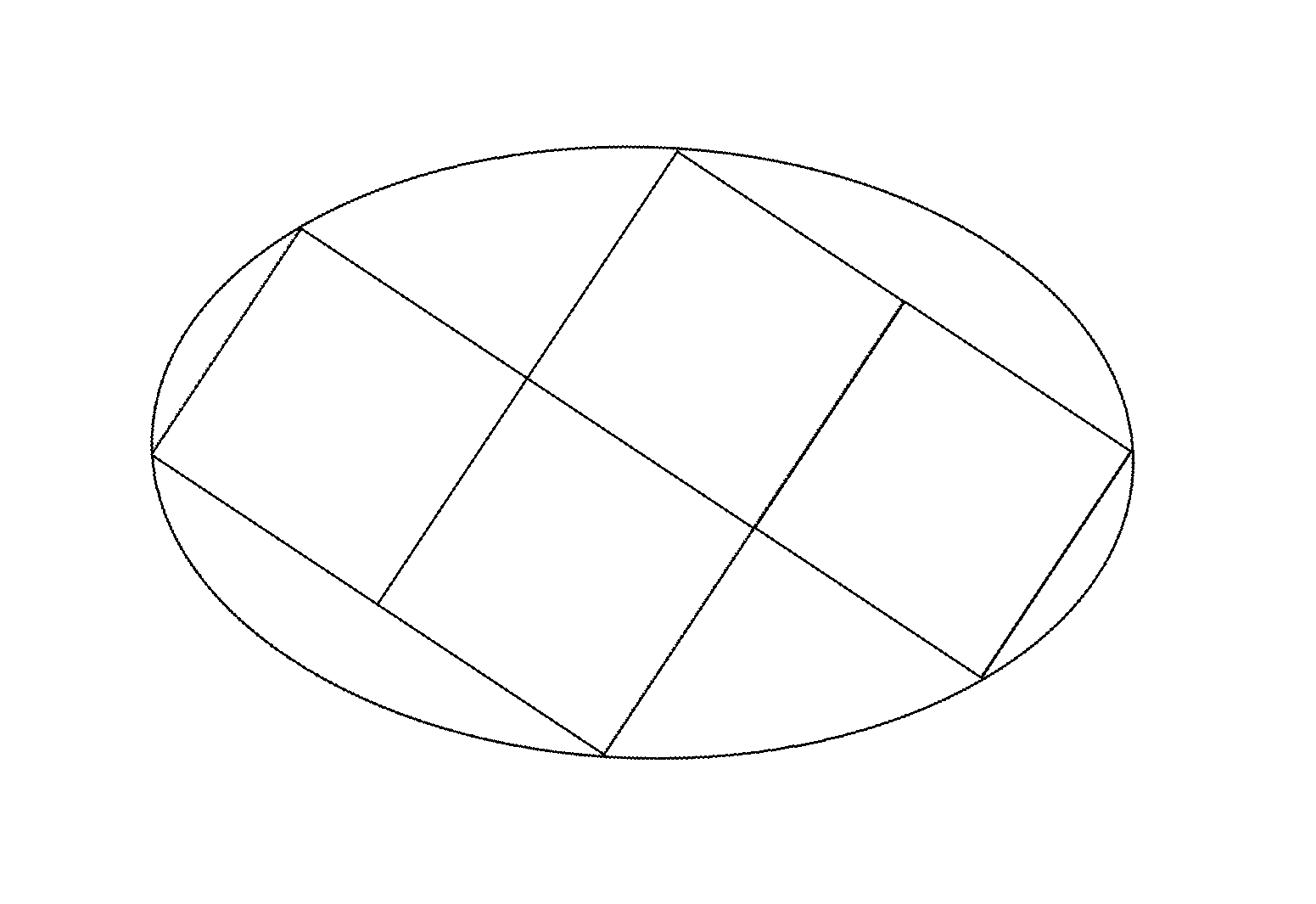
If you have a Tetris block like this, made from unit squares inside an ellipse so that six of the vertices are on the arc of the ellipse, what are the minor and major axes of the ellipse equal to?
>>17089016
>If a coin lands heads, there is...
>If it lands tails, the original coin is returned
What is the "original" coin? The "If a coin lands heads" line? This sounds like a contradiction.
>>17088803
Institutions hire shitters whose only purpose is writing endless responses to critique and drowning the output of competing institutions in bullshit critique in order to cripple their ability to publish. The institutions that can hire the most timewasting bullshit critique writers/responders gets to publish, every other institution gets put in a paper chastity cage and therefore gradually loses it's capacity to apply for funding. Meanwhile the actual scientific output of an institution is rendered entirely meaningless, since even the best research can get slapped with ehrm akshually technically not entirely wrong pointless timewasting critique, and meanwhile it doesn't help with producing your own critique. You have created an extremely agressive and rapid race to the bottom.
>"Nooooo it will work if the whole process is overseen by competent reasonable authorities acting in good faith"
Any fucking system ever works with oversight competent reasonable authorities acting in good faith. The whole point of due process is to have less reliance on personal qualities of participants.
>>17089885
I like you shitting on this idea. Valid.
The goal is to make sure only works that are worth publishing get published, so maybe this failure mode can be prevented by applying this same principle to publishing critique as well. An amendment to the original set of rules:
- every institution can only have one outbound critique standing at a given moment.
So, if you want to stall one specific opponent, you can continuously issue "ehrm ackshually" technicalities against their papers and all their responses, but since it is visible, and the less common it is the more visible it is, it might impact your reputation.
For most institutions, this will kill the incentive to submit unreasonable critique as you barely achieve anything with that. So attacking others will be worth your time only if it gives you some clout, e.g. when you spot an actual junk paper.
>>17089607
cut it out with the bot posts schizo.
>>17089844
I think the poster was assuming two coins, the fair "original" coin and the "rigged" coin.
The fair coin is flipped first. If heads, the "rigged" is flipped next.
But, this second coin may also be a fair coin as well, hence the 50%.
>>17089108
Can this be done using a probability tree diagram?
>>17090030
Only partly as an approximation. A tree is good for a fixed number of throws. For example, P(heads on throw 2) is found by summing branches, and the tree doubles in size with every throw. It can’t directly give a limit as the number of throws goes to infinity.
>>17088718
Does anyone have a reading list for advanced / experimental logic principles? It's been a while and I want to brush up on my fundamentals before approaching and going past Gödel.
>>17090028
Idk about that. Obviously we have
>0.) Fair coin def
[math] \begin{array}{c c c c}
F & \overset{50\%}{\rightarrow} & H \\
& \overset{50\%}{\rightarrow} & T \\
\end{array} [/math]
His OG post is
>1.) If a coin lands heads, there is a 50% probability that the next coin is rigged...
[math] \begin{array}{c c c c c c}
W_0 & \rightarrow & (X_0 := H) & \overset{a = 50\%}{\rightarrow} & F & \overset{50\%}{\rightarrow} & H \\
& & & & & \overset{50\%}{\rightarrow} & T \\
& & & \overset{b = 50\%}{\rightarrow} & R & \overset{80\%}{\rightarrow} & H \\
& & & & & \overset{20\%}{\rightarrow} & T \\
\end{array} [/math]
>2.) If the rigged coin also lands heads, it stays rigged for the next throw.
[math] \begin{array}{c c c c}
R & \overset{80\%}{\rightarrow} & (Y_0 := H) & \overset{0\%}{\rightarrow} & F \\
& & & \overset{100\%}{\rightarrow} & R \\
& \overset{20\%}{\rightarrow} & (Z_0 := T) & \overset{c\%}{\rightarrow} & F \\
& & & \overset{d\%}{\rightarrow} & R \\
\end{array} [/math]
>3.) If it lands tails, the 'original' coin is returned
If we assume >>17090028,
>I think the poster was assuming two coins, the fair "original" coin
then original means c = 100% and d = 0%. This implies that rule 3.) is meant to follow rule 1.). But this now means there are two instructions for H: X_0 and Y_0! Y_0 must always be preceded by R. Does this mean W_0 must always be F?
Or did 'original' mean X_0 and (c = d = a = b = 50%), so rule 3.) does not necessarily follow 1.)? If so, why in 1.) does he say "if it lands heads?
Honestly, this shit is why people need to get study english ffs. Too many questions here are just stupidly explained or communicated.

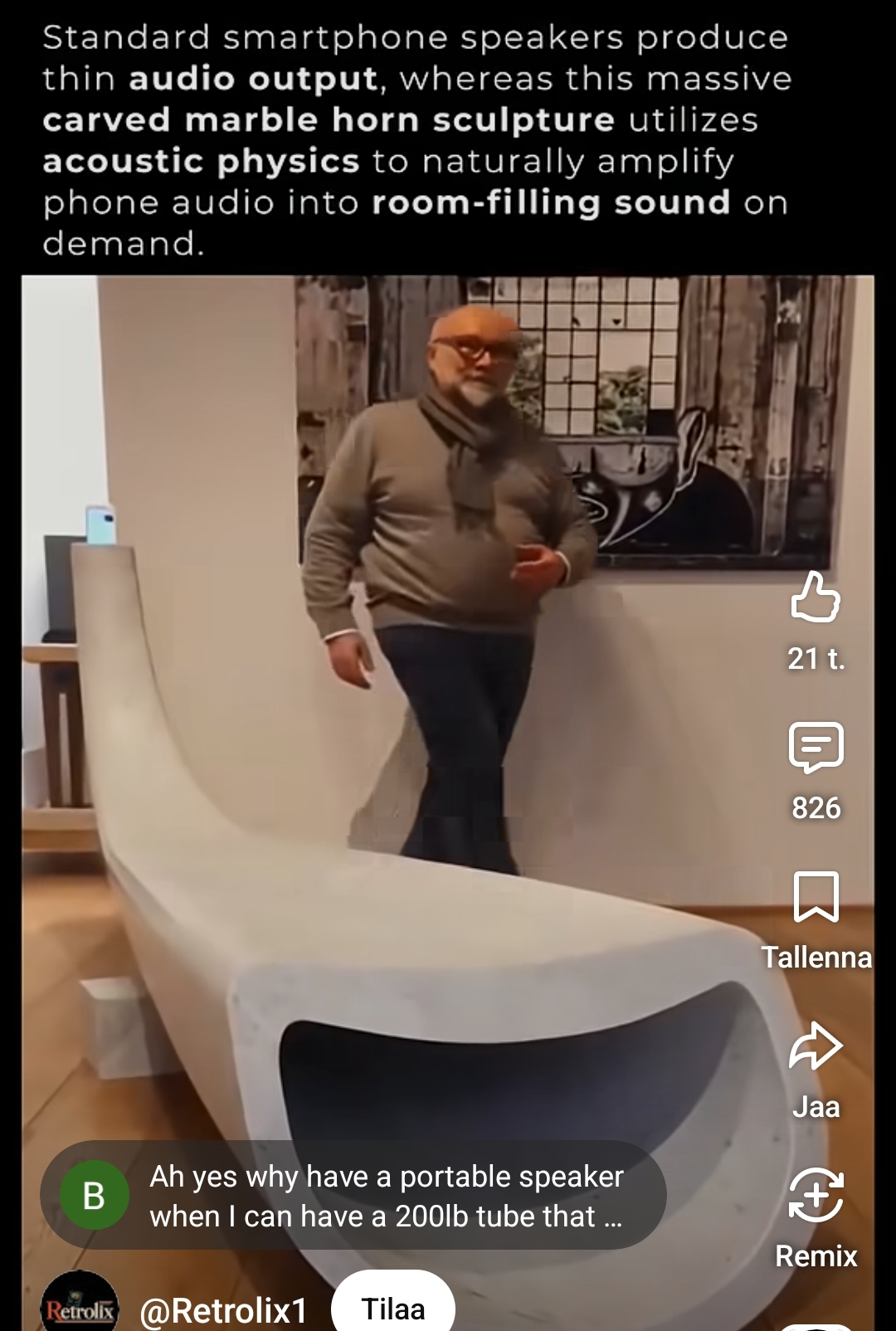
How can a device like this work? Sound is energy and the smartphone is always producing the same power to make sound. So how is the sound louder when it comes through the horn?
>>17090646
Because a horn, just like cupping your hands around your mouth, focuses the sound in a certain direction rather than the sound being spread out over a much wider area. So the same energy but a higher density (in a smaller volume)
>>17090646
I'm talking out of my ass here and this is just my guess
The pic says "thin" but this might not mean super weak. Maybe normal phone audio output has, idk, normal output. This output/energy goes into ALL directions. This horn is only a small section of a sphere. So of course it'll sound louder. It also seems to be reasonable to ask about the sound quality too. When the waves are bouncing off there walls of the horn, does it become more lossy?
Energy is always conserved though, and I doubt any is coming from the horn material and all power comes from the phone
Not a question, I just thought the following equation was cool because it uses all 5 of my favorite numbers: pi, e, i, phi, and 2 (the smallest prime):
e^(i*pi) + 2*phi = sqrt(5)
Notice that there are 5 numbers on the left side, so, of course, 5 also appears in the equation.
I also like the numbers 0 and 1, but it's always trivial to include those two numbers in any equation (just add 0 or multiply by 1), so I omitted those numbers because it's not challenging to include them.
In a discussion on brazing recently a few people have stated that a greater surface roughness is desirable for a better braze (presumably meaning a higher strength braze layer). I was under the impression that lower roughness was better, but I don't really know a lot about brazing.
Greater roughness would give greater surface area, so if brazing worked like glue then I could see that being true, but typically a braze forms an intermediate layer e.g. a carbide composed of both the braze material and the material being brazed on, so a greater surface roughness could lead to wetting issues when considering small pores, and more serious stress raisers for larger features.
Can anyone with experience on braze interfaces and strength comment?
>>17091575
>In a discussion on brazing recently
You must be fun at parties.
>>17091629
It was actually a work discussion, since brazing is an important topic for us right now, but even so I think it would be a good party conversation subject.

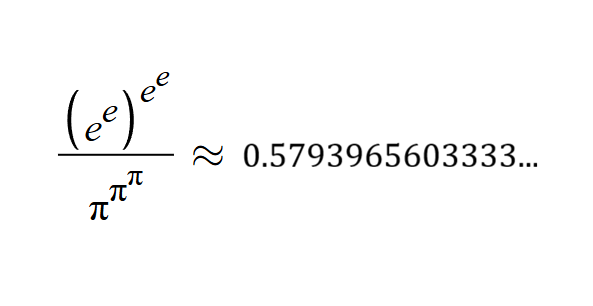
What are the chances this is an irrational number?
>>17094566
This doesn't directly answer your question, but I believe that the Gelfond-Schneider theorem says that any number of the form a^b is transcendental where a and b are algebraic (a ≠ 0 and a ≠ 1) and b is irrational.
However, in your case, a and b are transcendental, not algebraic. We do know of specific cases where a^b could be rational (such as a=e and b=ln 2), so I don't think Gelfond-Schneider will help here.
Sorry, that's all I have. AI doesn't seem to be much help either:
https://www.google.com/search?udm=50&complete=0&q=does+e%5Ee+evaluate+to+a+rational+number%3F
>>17094566
You want an uninformed probability or a Baysian posterior?
Because I am not giving you a straight yes/no answer under any circumstances.
Topology, bros. It is, oh, so based.
i want to study and learn as much as i am able to to what we humans and current research knows.
through school you go through arithmetic then algebra and trig to calculus etc. biology becomes biochemistry becomes chemistry becomes physics etc
philosophy and psychology seem to hit walls only answerable by neuroscience and seeing how the brain actually functions.
it seems like all roads lead to astrophysics, quantum mechanics, and neuroscience. are these topics really the endgame, the bottom of the iceberg meme if you will, when it comes to subjects to learn about what we currently know?
or subtopics. like everytime you look up ahything to study astronomy it starts with basic shit like constellations, scale, stars, etc eventually talking about relativity and usually stopping there. but what are the things beyond that that people are actually currently researching? or where can i go to actually learn about all that current research etc
It is my limited understanding that at the most fundamental level there is either one field with many characteristics or many fields that interact with each other creating an energetic sea of virtual particles, and calculating interactions with virtual particles or real particles requires the inclusion of all possible combinations. So, is it reasonable to assume this very energetic constant creation/destruction/evolution has tried and is trying every possible combination that has resulted in the 'finely tuned' existence we experience today? And, considering the complexity at the fundamental level is it reasonable to assume complex chemicals and complex life forms would natural evolve from it? If the basics were just stable boring particles how could that result in complex thinking life forms?
>>17095857
so based...

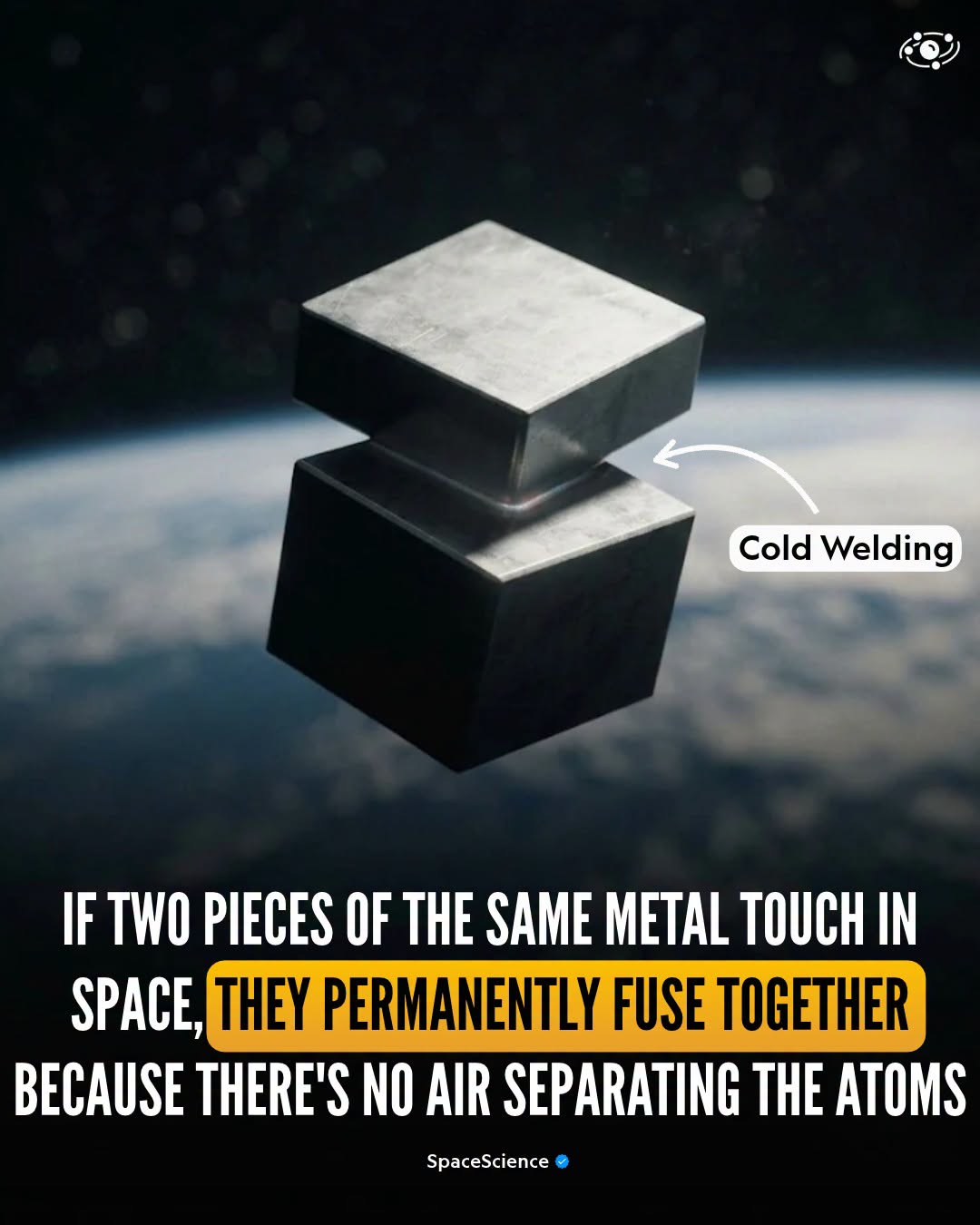
How legitimate is this?
>>17090646
>Same power
The impedance might match better, so it could be louder. A trumpet is louder than the same effort mouthpiece buzz.
>>17103310
What do you mean legitimate? It's a real effect. It doesn't even require space. All you need is to place the metal pieces in a vacuum.
>>17091711
yes
No coins yet. Be the first: [Launch a Coin From This Thread]